

Two roads diverged in the woods
Most lawyers start at law firms where the path ahead is clearly defined: trainee, associate, senior associate, partner. Fee-earners at a law firm are the rain-makers. If the firm is run well, everything is geared to help them succeed. There’s structure, people and snazzy tools. The bigger the firm, the greater the institutional stimulation. There are rules of progression and everyone is expected to understand them.
By contrast, in-house legal teams, are an ancillary unit, often seen as merely a “support function” and anecdotally, an expensive cost-base (if not altogether viewed as a blocker!). In-house teams very much lack pathways of progression. A capable legal counsel can aspire to be a General Counsel, but the journey is hardly mapped out, tools available are limited, and it is unlikely their career aspirations are understood by the wider business.
Forward-thinking legal leaders must change that paradigm.

The challenge
Apart from the “fog” blocking the view to the path to GC, in-house legal departments thrive on specialty areas. Businesses hire in-house counsel for their expertise in a particular area such as regulatory, commercial or litigation. While this deep expertise is crucial, it is a common pitfall that legal departments (or overprotective counsel!) create knowledge silos, leaving lawyers less equipped to understand the holistic needs of the business and effectively preventing their career from flourishing.
No matter how progressive an organisation is and how seriously it takes people development, to an organisation that is anything but a law firm, the in-house legal unit is not a priority for career development.
The question becomes: how do organisations develop lawyers who are not just technically excellent, but also business-minded professionals capable of leading future legal teams?
Growing in the flow: the “path to GC” framework
Most legal departments relegate learning to dedicated training sessions. Here’s a thought: weave training for growth into the daily operations and you will elevate your in-house team into an all-rounded intellectually curious and career motivated machine.
The path to become GC lies in three core areas:
- breadth of experience, almost never in specialty;
- their leader being a coach rather than a boss; and
- a feeling of being empowered with the motivation AND the right mindset to solve any problems ahead.
In order to turn these three points into actionable items, here’s a five-point recipe for success:
- Cross-specialty exposure
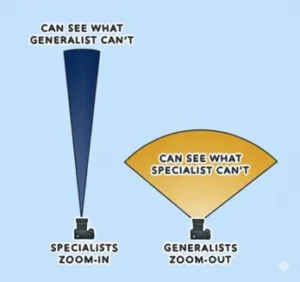
The clue to becoming a good General Counsel is in the title: you obviously need to become a generalist.
Rather than confining individuals to their niches, successful legal departments could encourage cross-disciplinary engagement. A regulatory lawyer, for example, might be invited to assist with commercial contracts or disputes. This exposure does not dilute expertise; quite to the contrary it deepens understanding of the business, it helps make the lawyer all-rounded.
When lawyers see how their area interacts with others, they become more insightful, pragmatic, and commercially attuned. A contracts lawyer who understands regulatory problems is better placed to deliver on commercial work; a litigation lawyer doing a contract every now and then becomes a better litigator, and moreover, a better lawyer.
Apart from legal expertise, crossing into another area means utilising another skill set – solving problems in litigation vs regulatory surely must involve different parts of the brain.
2. Pausing for pedagogy
Team meetings are important for status updates, they help everyone be on the same page. A progressive legal leader can transform these into learning hubs. When topics present teachable moments, a good leader should pause to unpack them for everyone’s benefit.
Here a great leader should turn into a professional coach. What is the problem presented? How can it be solved, efficiently? Any prior experiences to draw from? The point here being to provide a framework for the individual to find the answers. You do this by shifting the perspective from the “problem” to the “solution”.
Once problem dispensed with, are there any applicable learnings that can be adapted for general problem-solving which your team’s future GCs can add to their armour?
These organic learning moments help institutionalise knowledge-sharing and build a culture of curiosity within teams. Combined with a growth mindset which should be instilled into everyone (a topic for another blog), you have a recipe for natural growth.
Does a legal department ever have the time? Everyone knows the answer to that but start small, say 5-6 mins from each team meeting one person each week.
3. Beyond comfort: peer review and training
In-house lawyers should be regularly encouraged to try and solve the problem on their own. Where there’s an impression of being stuck, peer review will help. And if that does not solve the problem, by the time it reaches the General Counsel ready for their turning into a coach (see point 2 above), the likely solution has already started to narrow.
Equally important for legal counsels is to pursue training outside the primary domain of specialty – something that in fact well-managed legal departments often do. Bringing back ideas to share with others is where you really add value for growth.
A healthy combination of peer review and shared training shifts focus to growth and cross-fertilization, viewing the entire legal function as a collective of learners driving each other forward, rather than a group of isolated specialists.
4. Build to scale
Depending on the size of the legal team or department, it is imperative to design approaches that work to the size or the chosen organisational structure with the messaging tailored to suit.
With a tight unit made up of a GC and 3-4 senior lawyers, it is easy to maintain a close relationship as well as to know the strengths and weaknesses of each member. Similarly, in such a unit, the next stage in the career evolution for the majority of the team may indeed be the Head of Legal role, which presents problems in itself. However in an organisation where there are hundreds of lawyers with wide-ranging skill-sets, or say the organisation operates in specialist core units, that message may differ.

In any case, the path to GC concept is scalable – the point being that it is a mindset rather than a managing, training or delegation tool.
5. Empower like there’s no tomorrow
Last but the most important: in-house counsel need to be empowered from Day 1 that their future is to become a GC. They need to be so reminded on a regular basis so their work builds on blocks to get to the GC prize. In particular they need to be reminded in a moment of self-doubt. This will do wonders for their motivation. In return, the legal leader achieves a thriving legal team which is self-sustainable.
Do not confuse empowerment with Mr/Ms/Mx Nice management. It is a strategic imperative for sustainable competitive advantage.
Bonus points
To build a “path to GC” framework a leader hardly needs to consider 1) budgets; 2) the broad organisation’s cultural readiness; 3) resource allocation; 4) buy-in from other departments; and lots of other typical bureaucracy-type impediments. All that’s required is a mindset. Perhaps it is helpful if the People Team unit is aware of the initiative as it may come up in end-of-year reviews.
Overall the “path to GC” framework ought to remain an organic legal unit development framework – a tool by lawyers for lawyers. The framework is understood only by comparison to how lawyers develop in law firms, and is likely to not be understood by the rest of the business.
Concluding thoughts
The “path to GC” framework represents more than a training or management initiative – it is a mindset. Invest, coach and empower to multiply the value lawyers bring to the organisation and, in symbiosis, the career development of those lawyers.
Comments are closed